Primary Raynaud’s
Raynaud’s occurs on its own, without an identified underlying disease. Capillary structure is generally preserved.
A guide for patients and anyone curious
Your fingers change colour in the cold, and your doctor has requested a capillaroscopy. What are they looking for?
The test helps your doctor look for changes in tiny blood vessels that may point to an underlying condition. A referral does not mean you have an autoimmune disease. [2]
Reviewed by Borja del Carmelo Gracia Tello
Colour changes you notice
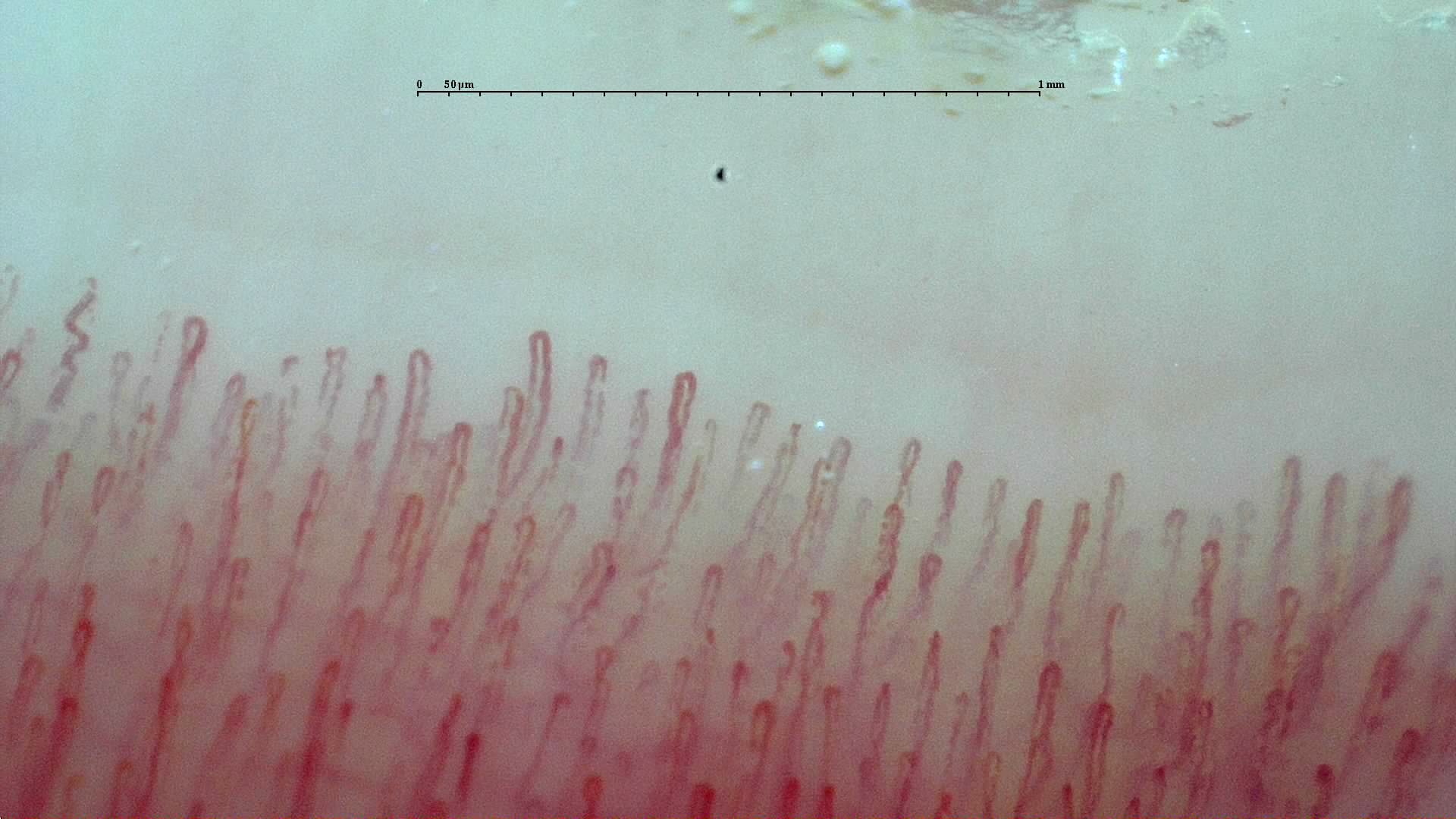
Tiny vessels your doctor examines
01 / Why this test?
In Raynaud’s, blood vessels temporarily narrow, often with cold or stress. Fingers may become pale, blue or red, with numbness or tingling. Not everyone notices all three colours, and changes look different on different skin tones. [1]
Raynaud’s occurs on its own, without an identified underlying disease. Capillary structure is generally preserved.
Raynaud’s is associated with another cause. Capillaroscopy helps look for changes linked to connective tissue diseases, particularly systemic sclerosis.
The history of your attacks and a clinical examination.
The shape, width and distribution of the tiny vessels.
Blood tests, such as antinuclear antibodies (ANA), when clinically appropriate.
Your doctor interprets these findings together. A microscope image alone cannot establish a diagnosis. [2]
02 / Your results
These are broad explanations of report terms, not a way to diagnose yourself from an image.
A normal examination supports primary Raynaud’s in the right clinical context. It does not rule out every underlying condition or remove the need to review new symptoms.
Some variations do not identify a particular disease. Your doctor considers their extent, image quality and the rest of your assessment.
A characteristic combination of vessel changes may suggest a connective tissue disease. It needs to be interpreted alongside symptoms and other tests; the report is not a diagnosis by itself.
Capillaroscopy.com — clinical Raynaud’s chapter and references [4]
No. Capillaroscopy does not hurt at all and is non-invasive. A microscope examines the area near your cuticles; there are no needles or cuts.
No. The examination looks at vessel structure between attacks. You do not need to bring on an attack for the test.
No. Abnormalities vary in significance. A nonspecific change is different from a scleroderma pattern, and even that pattern requires a full clinical assessment.
Sometimes. Follow-up depends on your symptoms, blood tests and initial findings. Your clinician will decide whether and when to repeat it; there is no single interval for everyone.
Reviewed by Borja del Carmelo Gracia Tello
Educational information to help you understand the test. Your clinician can explain what your own results mean.
How we review our content