Raynaud's phenomenon is a clinical syndrome before it is an etiologic diagnosis. The key question is not only whether the patient has vasospastic episodes, but whether this is a relatively benign primary form or the first expression of structural microangiopathy, especially within the scleroderma spectrum [1, 2, 3, 4].
- Diagnosis remains clinical and relies on a structured history of well-delimited, reversible episodes triggered by cold or stress [1, 2, 3].
- Capillaroscopy and antinuclear antibodies (ANA) are the most useful tests for separating primary Raynaud from secondary autoimmune-spectrum forms [2, 3, 4].
- A normal or nearly normal capillaroscopic study does not mean zero risk, but it substantially lowers the probability of scleroderma-pattern microangiopathy, at least at that point in time [2, 3, 4].
- The risk of progression rises markedly when specific autoantibodies and puffy fingers coexist with capillaroscopic abnormalities [6, 7].
- Non-pharmacologic measures remain the basis of treatment; when they are insufficient, dihydropyridine calcium channel blockers are the first pharmacologic option [2, 3, 9, 10, 11].
- Persistent pain, ulcers, necrosis, clear asymmetry, or symptoms outside the episodic pattern require prompt investigation for secondary causes or critical ischemia [2, 3, 9].
Learning path
You are in the setting where capillaroscopy shapes the most clinical decisions: Raynaud's phenomenon. You can then go deeper into the scleroderma pattern, criteria, and classification if your main question is systemic sclerosis risk, or into other vascular acrosyndromes if you want to refine the differential diagnosis.
What we call Raynaud
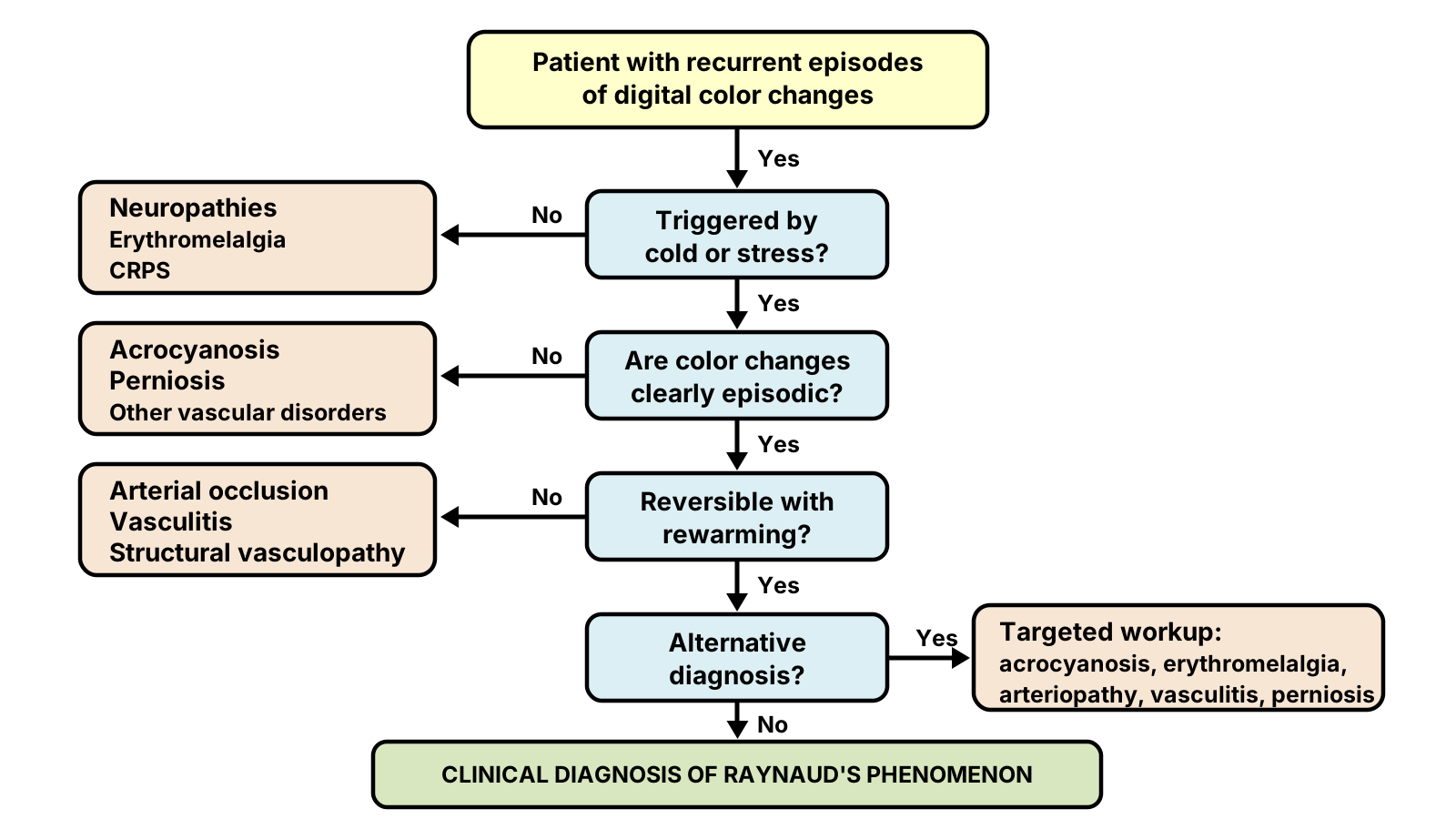
Not every cold or violaceous finger is Raynaud. Diagnosis starts from an episodic pattern of vasospasm, with well-delimited and reversible color changes triggered by cold or stress and recognizable in the clinical history [1, 2, 3].
International consensus criteria reinforced a practical idea: Raynaud is not diagnosed from a single photograph, but from a compatible and sufficiently specific history [1]. The classic sequence is pallor, cyanosis, and rubor, but not all phases need to be equally evident in every episode. In real clinical practice, the most useful point is to confirm that episodes are paroxysmal, reversible, delimited, and clearly inducible by typical triggers [1, 2, 3].
Most patients present with involvement of the fingers; feet, nose, ears, or nipples may also be affected [2, 3]. Thumb involvement is less common and, when striking or very early, should raise concern for secondary causes or an alternative diagnosis. Similarly, persistent pain outside attacks, marked asymmetry, or ulceration does not fit well with simple primary Raynaud [2, 3, 9].
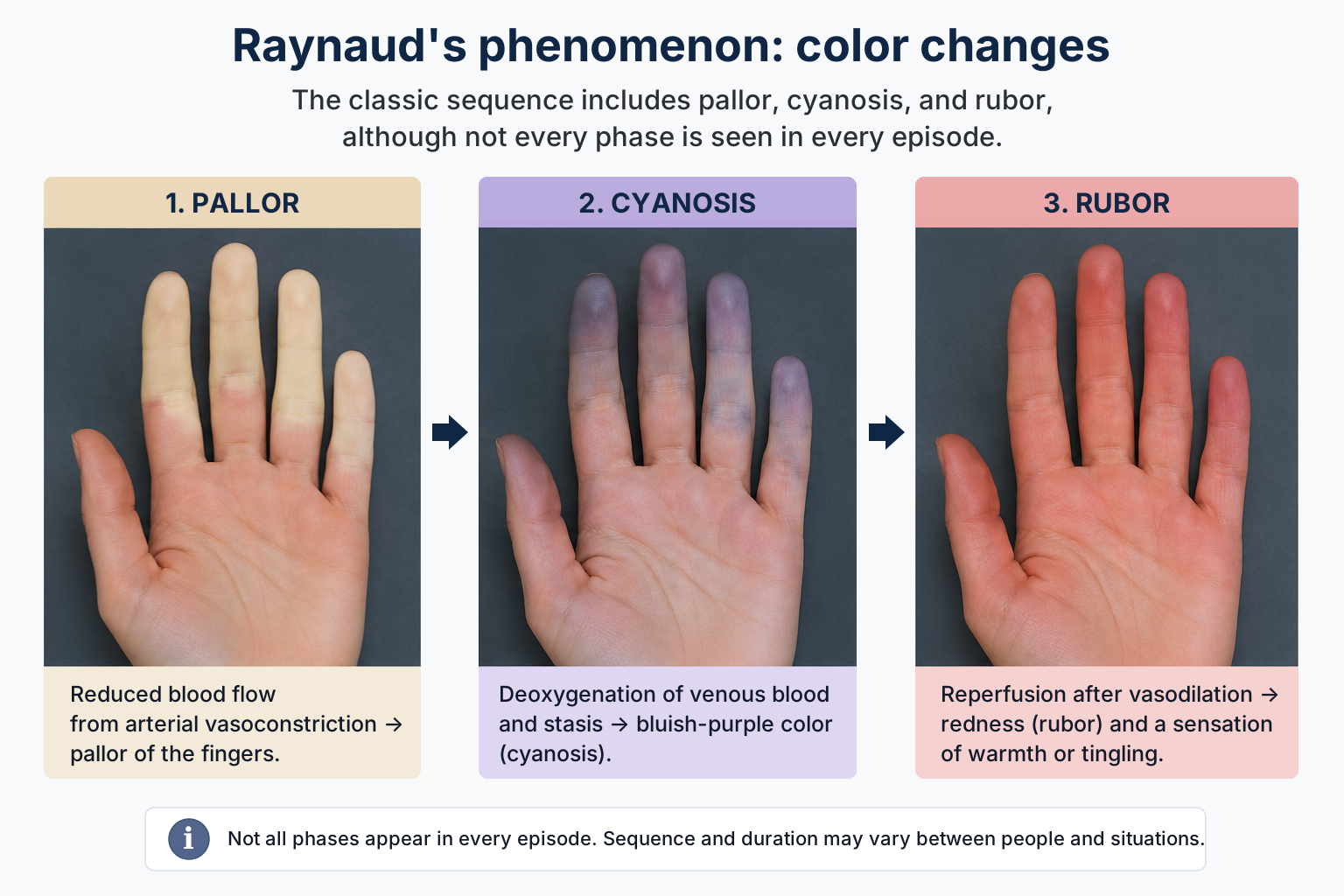
| Clinical question | What supports Raynaud | What raises doubt |
|---|---|---|
| Is it episodic? | Reversible attacks triggered by cold or stress [1, 2, 3] | Persistent cyanosis, constant warmth, or a fixed lesion |
| Is there a typical color change? | Pallor or blanching, with or without cyanosis and rubor [1, 2, 3] | Isolated erythema or permanent violaceous color |
| What is the distribution? | Bilateral and relatively symmetric | Unilateral, very asymmetric, or centered on a single finger |
| What happens between attacks? | Functional recovery between episodes | Continuous pain, ulcers, necrosis, or persistent edema [2, 3, 9] |
Primary versus secondary
The main clinical goal is not to prove vasospasm, but to identify whether it occurs as part of an underlying disease, especially a connective tissue disease.
Primary Raynaud usually begins in young people, tends to be symmetric, and rarely produces permanent tissue ischemia. Secondary Raynaud, by contrast, may appear later in life and may be associated with more intense pain, ulceration, skin signs, autoantibodies, or structural capillary microangiopathy [2, 3, 9]. This distinction matters because it changes prognosis, diagnostic urgency, and follow-up.
| Feature | Suggests primary Raynaud | Suggests secondary Raynaud |
|---|---|---|
| Age at onset | Earlier, often before age 30 [2, 3] | Late onset or clear change in pattern in adulthood [2, 3, 9] |
| Distribution | Symmetric and without tissue damage | Asymmetric, with persistent pain, ulcers, or necrosis [2, 3, 9] |
| Physical examination | No sclerodactyly, telangiectasias, or puffy fingers | Puffy fingers, sclerodactyly, telangiectasias, calcinosis, or arthritis [2, 3, 6] |
| ANA and autoantibodies | Negative or without high clinical suspicion | Positive ANA or systemic sclerosis-specific autoantibodies [2, 6, 7] |
| Capillaroscopy | Normal or nearly normal [2, 3, 4, 5] | Scleroderma pattern or repeated structural abnormalities [4, 6, 7] |
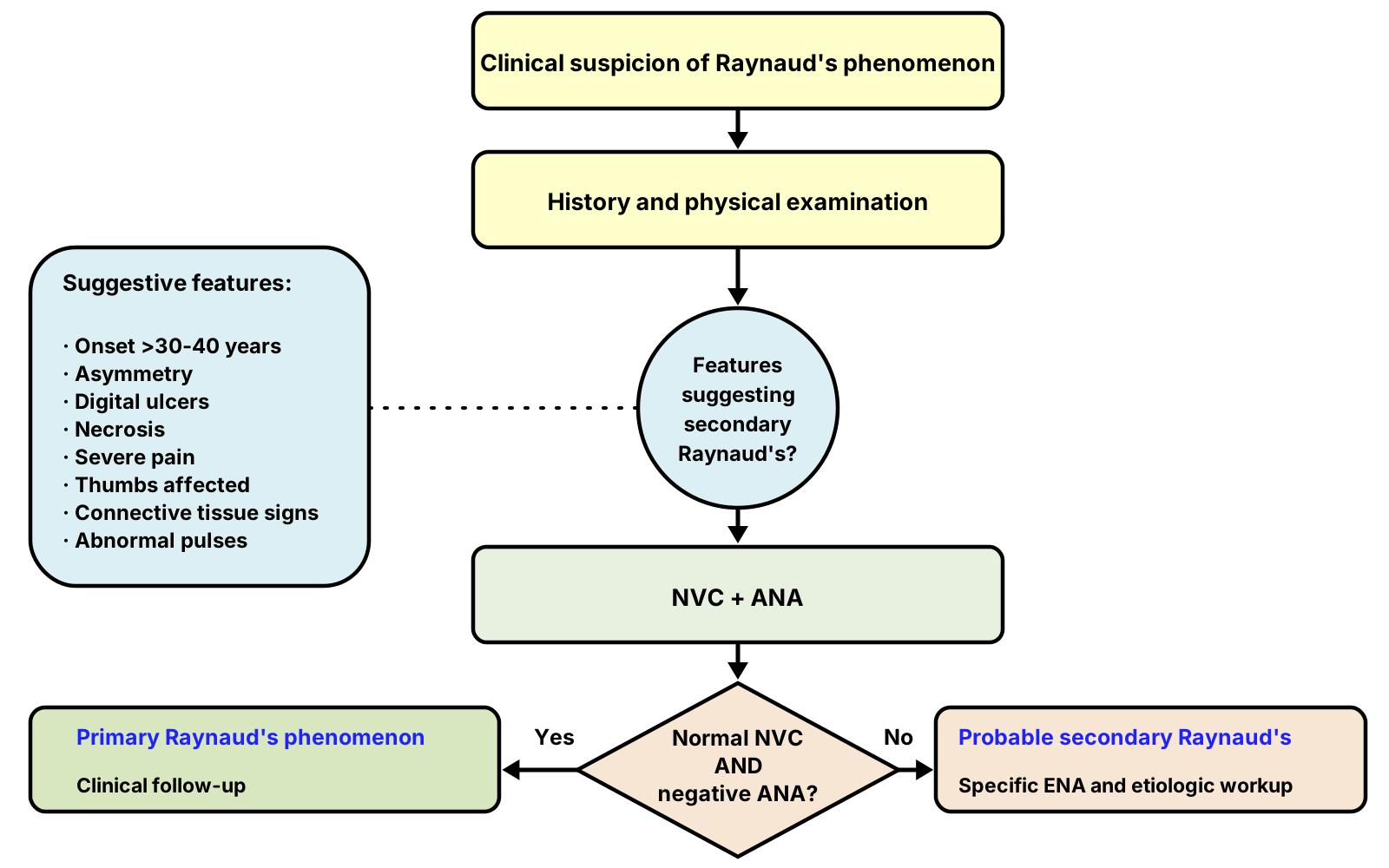
Causes of secondary Raynaud may lie outside rheumatology. They include connective tissue diseases, drugs, hematologic disorders, hyperviscosity syndromes, endocrine disorders, vibration exposure, arterial or compressive disease, and other vascular contexts [2, 3, 9]. However, the most relevant diagnostic problem for capillaroscopy remains distinguishing primary Raynaud from Raynaud within the scleroderma spectrum.
Role of capillaroscopy and serology
In Raynaud, capillaroscopy is not an "ornamental" test: it is a stratification tool. Its value increases when interpreted together with ANA and clinical examination.
The 2020 standardization consolidated capillaroscopy as a reference test in the assessment of patients with Raynaud and suspected systemic sclerosis [4]. In primary Raynaud, the expected finding is normal or nearly normal capillaroscopy. That said, "nearly normal" does not always mean perfect. A 2024 study found that people with primary Raynaud could show nonspecific morphologic abnormalities such as dilations or relatively lower density more often than controls, without this by itself implying a scleroderma pattern [5].
This nuance matters because it avoids two opposite errors: trivializing any slight abnormality and, at the same time, turning it into early systemic sclerosis without enough basis. What does matter is the combination of marked dilation, capillary loss, hemorrhages, and disorganization, especially when associated with positive ANA, puffy fingers, or specific autoantibodies [4, 6, 7].
Example of primary Raynaud
Complete capillaroscopy from a primary Raynaud case, with globally preserved architecture.
Example of secondary Raynaud
Complete capillaroscopy from a case with systemic sclerosis (SSc) and Sjögren's syndrome.
| Test | What it adds | Limitation |
|---|---|---|
| Capillaroscopy | Detects structural microangiopathy and scleroderma pattern [4, 5, 6, 7] | Does not classify all connective tissue diseases by itself [2, 4] |
| ANA | Baseline stratification and selection of follow-up [2, 6] | Isolated positivity without context may be nonspecific |
| Systemic sclerosis-specific autoantibodies | High progression risk when they coexist with abnormal capillaroscopy [6, 7] | Do not replace longitudinal clinical assessment |
| Other tests | Driven by suspicion: complete blood count, erythrocyte sedimentation rate (ESR), C-reactive protein (CRP), cryoglobulins, vascular profile | Low yield if ordered without a clinical question |
Progression and follow-up
The major utility of capillaroscopy in Raynaud is not only diagnostic; it is also prognostic. It helps decide who needs routine control and who requires close surveillance.
Koenig's prospective study of 586 patients showed that 12.6% progressed to definite systemic sclerosis during follow-up. The combination of specific autoantibodies and abnormal capillaroscopy at the baseline visit was associated with a very high probability of progression, 79.5%, while absence of both factors almost ruled out that outcome [7].
The Very Early Diagnosis of Systemic Sclerosis (VEDOSS) registry provided even more evidence in a multicenter cohort: overall progression was 52.4% at five years, absence of ANA was the most protective factor, with progression in only 10.8% of ANA-negative patients, while the combination of systemic sclerosis-specific autoantibodies and puffy fingers reached up to 94.1% progression [6]. In other words, not all Raynaud is the same, and risk changes greatly when capillaroscopy, autoantibodies, and examination are integrated.
Other capillaroscopic scales, such as PRINCE, have attempted to refine prognosis within isolated Raynaud. In this index, giant capillaries, hemorrhages, and the number of capillaries were the components with greatest prognostic weight, and the first two were associated with greater risk of developing a scleroderma-spectrum disorder [8].
| Baseline situation | Practical interpretation | Follow-up orientation |
|---|---|---|
| Negative ANA and normal capillaroscopy | Low risk of immediate progression [6, 7] | More spaced follow-up if clinical features are stable |
| Positive ANA without scleroderma pattern | Gray zone; risk depends on the whole context [2, 6] | Individualized clinical and capillaroscopic reassessment |
| Dilated capillaries or isolated giant capillaries | Not always equivalent to systemic sclerosis, but deserve closer attention [5, 7, 8] | Closer control, especially if autoantibodies are present |
| Specific autoantibodies + abnormal capillaroscopy | High risk of progression to the scleroderma spectrum [6, 7] | Close follow-up and directed systemic assessment |
Initial management and red flags
Treatment is best organized by severity and etiologic context rather than by a rigid list of drugs. In mild primary Raynaud, the foundation is often still non-pharmacologic.
General measures
Cold avoidance, thermal clothing, smoking cessation, and review of potentially vasoconstrictive drugs remain first-level measures in most reviews and consensus documents [2, 3, 9, 10]. In clinic, it helps to be concrete: gloves to open the freezer, warming before going outside, avoiding abrupt temperature changes, and reviewing beta-blockers or sympathomimetics when clinically possible.
Initial pharmacologic treatment
When general measures are not enough, dihydropyridine calcium channel blockers, especially nifedipine or amlodipine, are still considered the first pharmacologic option [2, 9, 10, 11]. Evidence supporting other vasodilators in primary Raynaud exists but is less uniform; the 2021 Cochrane review emphasized precisely that calcium channel blockers remain the reference and that evidence for other alternatives is more limited [11].
In more severe disease or systemic sclerosis-related disease, phosphodiesterase-5 (PDE5) inhibitors, topical nitrates, or intravenous prostanoids may have a role; endothelin antagonists are mainly reserved to prevent new digital ulcers in selected scenarios. However, this belongs more to specialized management of established vascular damage than to standard treatment of primary Raynaud [9, 10]. Therefore, treatment schemes designed for digital ischemia in the scleroderma spectrum should not be automatically transferred to a patient with mild primary Raynaud.
When to accelerate workup or refer
- Continuous pain between attacks or ischemia that no longer seems purely episodic.
- Digital ulcers, necrosis, infection, or tissue loss [2, 3, 9, 10].
- Clear asymmetry, very abrupt onset, or involvement of a single hand.
- Puffy fingers, sclerodactyly, telangiectasias, or systemic signs of connective tissue disease [2, 6].
- Abnormal capillaroscopy with positive ANA or specific autoantibodies [4, 6, 7].
Short clinical cases
Short cases help anchor diagnostic logic better than a long list of secondary causes.
Case 1: probably primary Raynaud
A 23-year-old woman has symmetric episodes of pallor and rubor when entering cold rooms. There is no persistent pain, no ulcers, negative ANA, and normal capillaroscopy. A reasonable approach is thermal education, habit review, and clinical follow-up if the pattern changes.
Case 2: Raynaud in a gray zone
A 34-year-old woman has had Raynaud for two years, positive ANA, no specific autoantibodies, an isolated capillary dilation, and no clear skin signs. The key word is caution: do not simply call it primary, but do not label a defined connective tissue disease either. Longitudinal clinical and capillaroscopic follow-up is warranted.
Case 3: high-risk Raynaud
A 41-year-old patient has painful Raynaud, puffy fingers, positive ANA, and capillaroscopy with giant capillaries, hemorrhages, and density loss. This profile is much closer to the high-risk group described in VEDOSS and historical progression cohorts [6, 7]. Systemic assessment should not be delayed.
FAQ
Is Raynaud diagnosed by a test or by the clinical history?
Mainly by the clinical history. Tests classify risk and look for secondary causes; they do not replace a well-taken history [1, 2, 3].
Does Raynaud with positive ANA necessarily mean secondary Raynaud?
Not necessarily. It increases suspicion and changes follow-up, but the real weight depends on the rest of the clinical context and capillaroscopy [2, 4, 6].
Does normal capillaroscopy completely rule out connective tissue disease?
No. It substantially reduces the probability of baseline scleroderma-pattern microangiopathy, but it does not replace longitudinal clinical observation [2, 4, 6, 7].
Can there be nonspecific findings in primary Raynaud?
Yes. Recent studies show that mild or nonspecific changes may exist, so interpretation must be contextual and not binary [5].
What is the most commonly used first drug when general measures fail?
Dihydropyridine calcium channel blockers, especially nifedipine or amlodipine, remain the most widespread first option [2, 9, 10, 11].
Glossary
- Primary Raynaud
- Raynaud's phenomenon without demonstrable causal disease and without evidence of significant structural vascular damage at baseline assessment.
- Secondary Raynaud
- Raynaud's phenomenon associated with an underlying disease, drug, or vascular disorder.
- VEDOSS
- Very Early Diagnosis of Systemic Sclerosis strategy based on combining clinical features, autoantibodies, and capillaroscopy.
- Giant capillary
- Homogeneously dilated capillary loop; the preferred term in many recent texts and equivalent to the historical megacapillary. In video capillaroscopy it is usually reserved for apical diameters of 50 μm or more, while smaller dilations are often described above 20 μm.
- Critical digital ischemia
- Persistent vascular damage threatening tissue viability, with severe pain, ulcers, or necrosis; it should not be managed as banal Raynaud.
References
- Maverakis E, Patel F, Kronenberg DG, Chung L, Fiorentino D, Allanore Y, et al. International consensus criteria for the diagnosis of Raynaud's phenomenon. J Autoimmun. 2014;48-49:60-65. doi: 10.1016/j.jaut.2014.01.020. PMID: 24491823.
- Pauling JD, Hughes M, Pope JE. Raynaud's phenomenon-an update on diagnosis, classification and management. Clin Rheumatol. 2019;38(12):3317-3330. doi: 10.1007/s10067-019-04745-5. PMID: 31420815.
- Ture HY, Lee NY, Kim NR, Nam EJ. Raynaud's Phenomenon: A Current Update on Pathogenesis, Diagnostic Workup, and Treatment. Vasc Specialist Int. 2024;40:26. doi: 10.5758/vsi.240047. PMID: 39040029.
- Smith V, Herrick AL, Ingegnoli F, Damjanov N, De Angelis R, Denton CP, et al. Standardisation of nailfold capillaroscopy for the assessment of patients with Raynaud's phenomenon and systemic sclerosis. Autoimmun Rev. 2020;19(3):102458. doi: 10.1016/j.autrev.2020.102458. PMID: 31927087.
- Brunner-Ziegler S, Dassler E, Müller M, Pratscher M, Forstner NFFM, Koppensteiner R, et al. Capillaroscopic differences between primary Raynaud phenomenon and healthy controls indicate potential microangiopathic involvement in benign vasospasms. Vasc Med. 2024;29(2):200-207. doi: 10.1177/1358863X231223523. PMID: 38334058.
- Bellando-Randone S, Del Galdo F, Lepri G, Czirják L, Denton CP, Guiducci S, et al. Progression of patients with Raynaud's phenomenon to systemic sclerosis: a five-year analysis of the European Scleroderma Trial and Research group multicentre, longitudinal registry study for Very Early Diagnosis of Systemic Sclerosis (VEDOSS). Lancet Rheumatol. 2021;3(12):e834-e843. doi: 10.1016/S2665-9913(21)00244-7. PMID: 38287630.
- Koenig M, Joyal F, Fritzler MJ, Roussin A, Abrahamowicz M, Boire G, et al. Autoantibodies and microvascular damage are independent predictive factors for the progression of Raynaud's phenomenon to systemic sclerosis: a twenty-year prospective study of 586 patients, with validation of proposed criteria for early systemic sclerosis. Arthritis Rheum. 2008;58(12):3902-3912. doi: 10.1002/art.24038. PMID: 19035499.
- Ingegnoli F, Boracchi P, Gualtierotti R, Zeni S, Lubatti C, Zahalkova L, et al. Prognostic model based on nailfold capillaroscopy for identifying Raynaud's phenomenon patients at high risk for the development of a scleroderma spectrum disorder: PRINCE (prognostic index for nailfold capillaroscopic examination). Arthritis Rheum. 2008;58(7):2174-2182. doi: 10.1002/art.23655. PMID: 18576359.
- Belch J, Carlizza A, Carpentier PH, Constans J, Khan F, Wautrecht JC, et al. ESVM guidelines - the diagnosis and management of Raynaud's phenomenon. Vasa. 2017;46(6):413-423. doi: 10.1024/0301-1526/a000661. PMID: 28895508.
- Herrick AL. Evidence-based management of Raynaud's phenomenon. Ther Adv Musculoskelet Dis. 2017;9(12):317-329. doi: 10.1177/1759720X17740074. PMID: 29201156.
- Su KYC, Sharma M, Kim HJ, Kaganov E, Hughes I, Abdeen MH, et al. Vasodilators for primary Raynaud's phenomenon. Cochrane Database Syst Rev. 2021;5(5):CD006687. doi: 10.1002/14651858.CD006687.pub4. PMID: 33998674.
- Casanegra AI, Shepherd RF. Raynaud Phenomenon and Other Vasospastic Disorders. Cardiol Clin. 2021;39(4):583-599. doi: 10.1016/j.ccl.2021.06.010. PMID: 34686269.