Shape
What do the loops look like?
Many normal capillaries look like slender hairpins. The clinician examines their outline and looks for unusual shapes across the images.
A painless, non-invasive test that uses a microscope to look at the tiny blood vessels at the base of your fingernails. Doctors study the images to see whether the vessels look normal or show changes.
Reviewed by Borja del Carmelo Gracia Tello
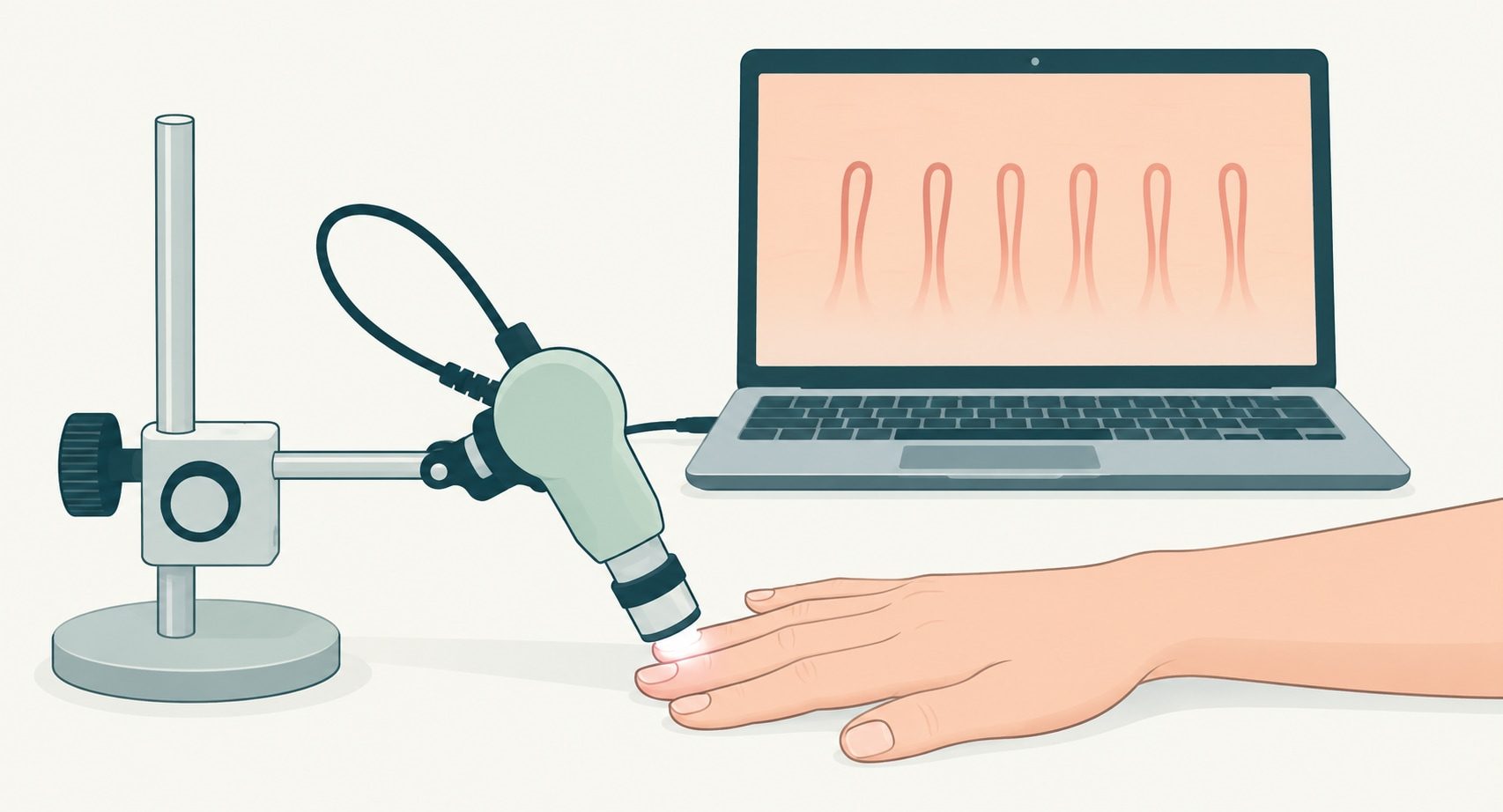
At your fingertipThe microscope looks through the skin.
On the screenThe tiny vessels become visible.
Simplified illustration · not to scale
01 / The microscope
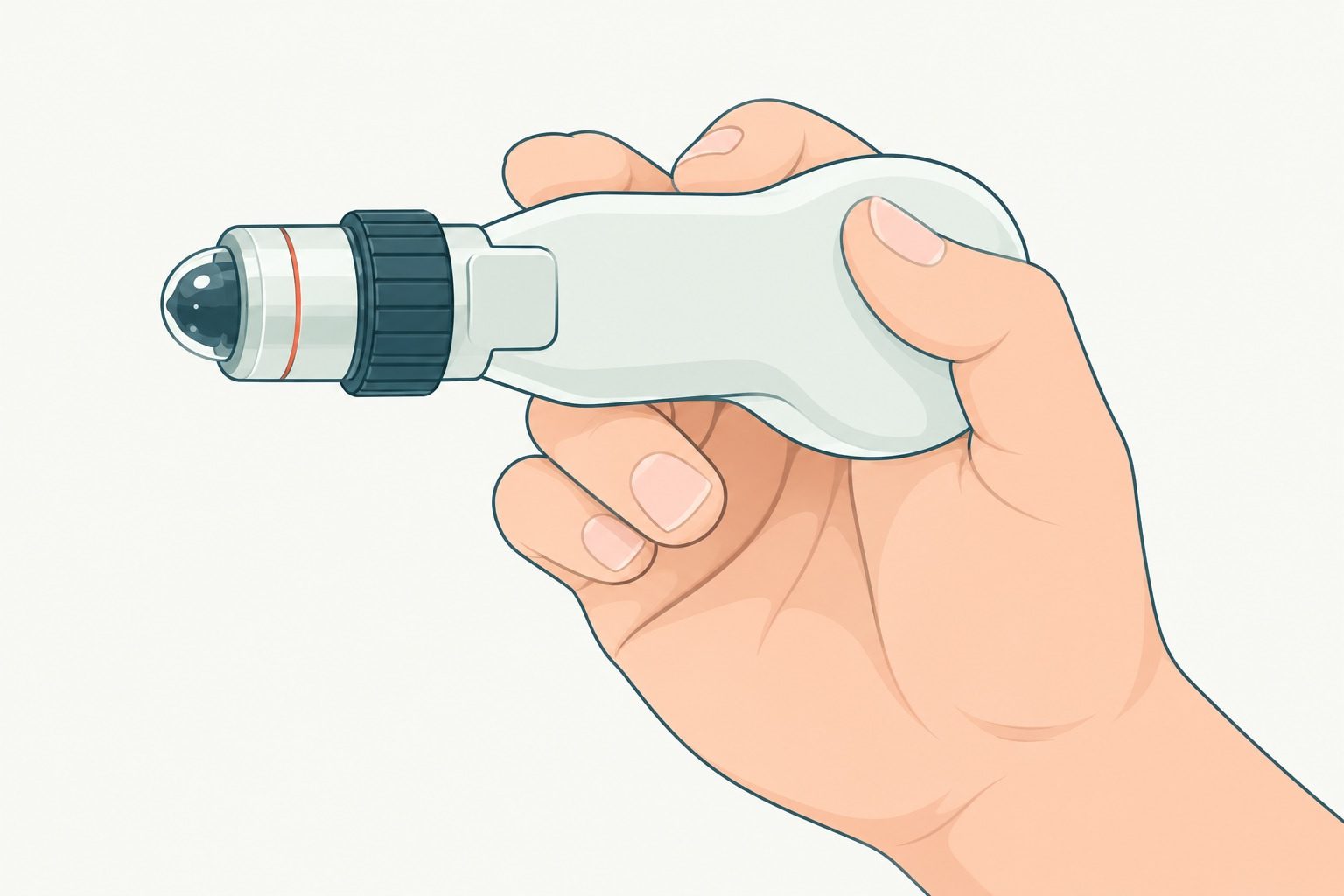
A capillaroscope is a microscope for looking at tiny blood vessels through the skin. A light illuminates the nailfold and a lens magnifies the view.
When it includes a camera, it is called a videocapillaroscope. The images appear on a screen and can be saved for the doctor to study.
It stays outside the skin. Nothing is inserted into your finger.
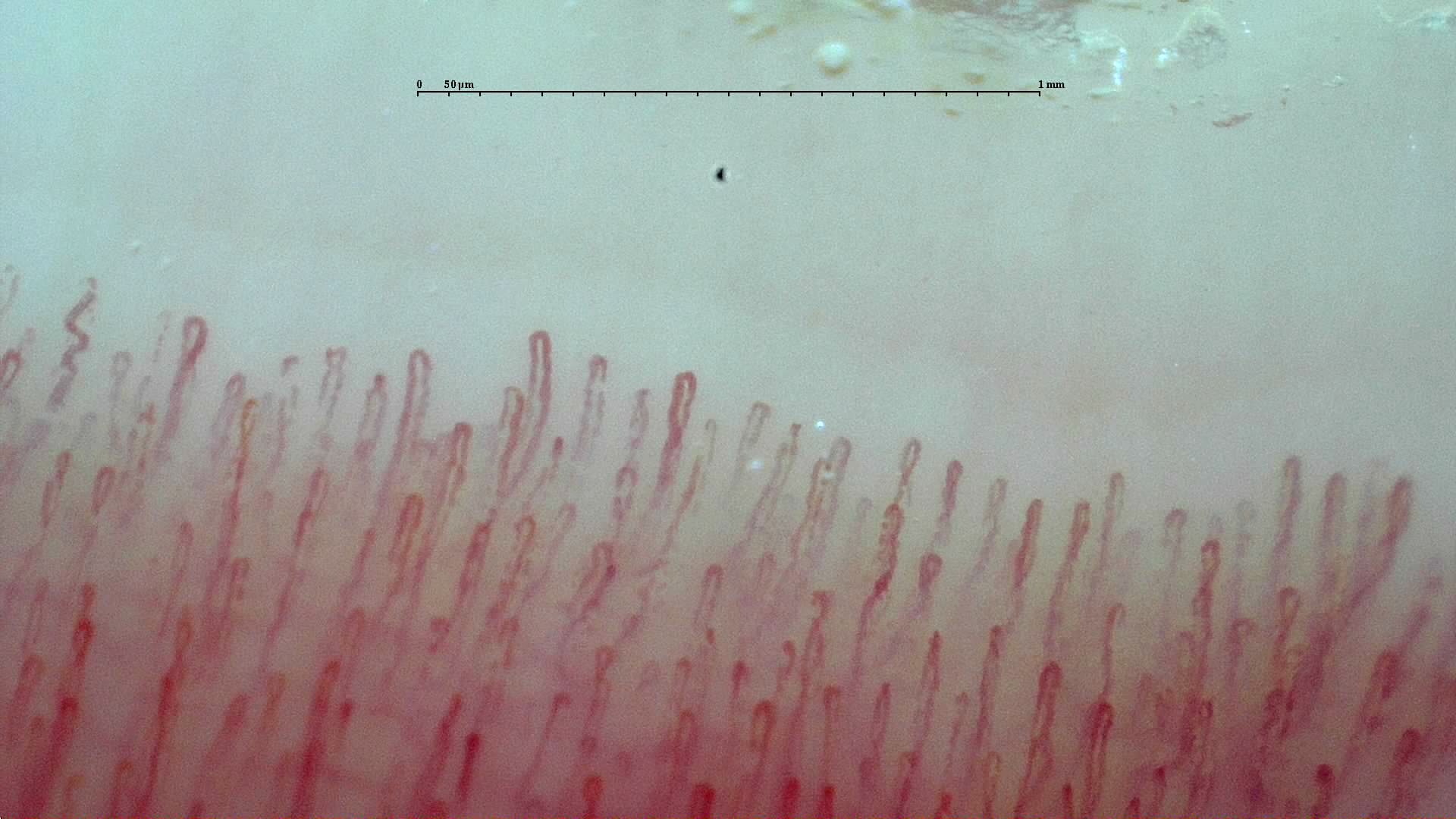
02 / The images
The small red loops in this image are capillaries. The doctor studies their shape, size and distribution to assess whether they look normal or show changes.
A closer look at the same tiny vessels, from three different perspectives.
What do the loops look like?
Many normal capillaries look like slender hairpins. The clinician examines their outline and looks for unusual shapes across the images.
How wide are the limbs and apex?
The clinician examines the width of each limb and the apex — the curved tip of the loop. These can have different widths, as the illustration shows.
How are they spaced?
The clinician checks how many capillaries are present along the nailfold and how evenly they are arranged, including whether there are gaps.
Simplified illustrations, not measurement scales. Normal vessels vary: the overall pattern across several fingers matters more than one unusual loop.
Can be reassuring, but does not rule out every condition. Your symptoms and other results still matter.
Does not automatically mean disease. Minor injury and normal variation can affect the appearance.
May guide further assessment or follow-up. Your doctor explains what it means in your situation.
Capillaroscopy cannot provide a diagnosis on its own. It is interpreted alongside your history, examination and, when needed, blood tests.
03 / Why it’s used
Capillaries are the body’s smallest blood vessels. At the nailfold — the skin at the base of the nail — they can be seen through the skin with a special microscope. That is why the test is called nailfold capillaroscopy.
Fingers that change colour with cold or stress may have Raynaud’s phenomenon. Capillaroscopy helps assess whether it occurs on its own or alongside another condition.
Some capillary changes can point towards a connective tissue disease, especially systemic sclerosis (a form of scleroderma). They are one part of the assessment.
When appropriate, a specialist can compare examinations over time alongside symptoms and other tests.
A plain-language guide to the test and what the results can mean.
04 / Your appointment
The test does not hurt and is non-invasive. You sit with your hands supported while a clinician looks at the skin beside your nails. There are no needles, cuts or skin samples.
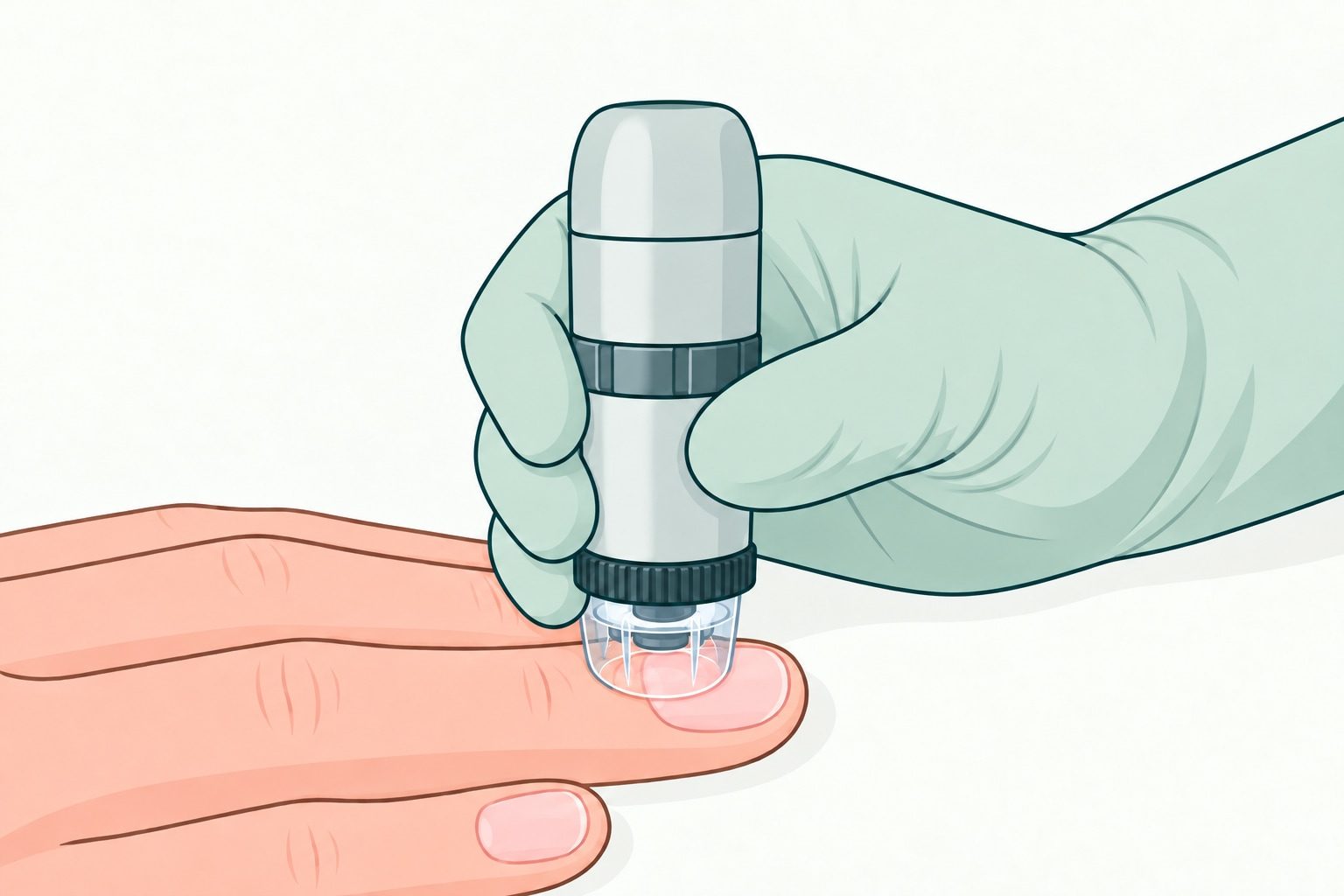
Rest in a comfortably warm room so your hands can adjust to the temperature.
A little oil on the nailfold helps make the vessels easier to see.
A microscope or camera examines several fingers and records images.
The oil is wiped away. The test itself usually needs no recovery time.
Follow your clinic’s instructions about nail polish or artificial nails. Avoid cutting or pushing back your cuticles beforehand: small injuries can affect the images. Ask the clinic about any preparation you are unsure of.
The test often takes around 20 minutes; allow extra time for preparation and warming your hands. Your clinic can confirm the appointment length.
05 / Common questions
The essentials, without the technical detail.
No, capillaroscopy does not hurt. It is a painless, non-invasive examination: the microscope looks at the blood vessels through the skin, without needles, cuts or injections.
No. Capillaroscopy takes images of small blood vessels through the skin. A blood test may be requested separately as part of your assessment.
No. Cold hands alone do not determine whether capillaroscopy is needed. A doctor considers your symptoms and examination before deciding if it would help.
Pictures can help you learn what the test shows, but cannot establish your diagnosis. The quality of the images, findings across several fingers and your medical history all matter.
It is capillaroscopy using a camera that displays magnified images on a screen. The images can be saved for measurement and comparison at later visits.
Keep exploring · Medical education
Everyone is welcome to explore. Our in-depth curriculum, pattern guides and clinical cases are written for doctors and other health professionals, using medical terminology and clinical evidence.
Anatomy, equipment and examination technique.
Explore fundamentalsFor doctors & health professionalsNormal findings and clinically relevant changes.
Explore patternsFor doctors & health professionalsReal images with clinical context and interpretation.
Explore clinical casesThis introduction draws on patient information from NHS services and our clinical learning materials.
This guide provides general education for everyone. It does not replace a consultation or an individual explanation of your results.
Our editorial policy